Tragedy, Resilience, and Hope: My Conversation With Rabbi Leo Dee
In Efrat, I met a father who lost his wife and two daughters to terrorism. His grief was sobering. His resilience, faith, and hope were deeply encouraging.
Some interviews stay with me long after the cameras stop rolling. My conversation with Rabbi Leo Dee in Efrat was one of them.
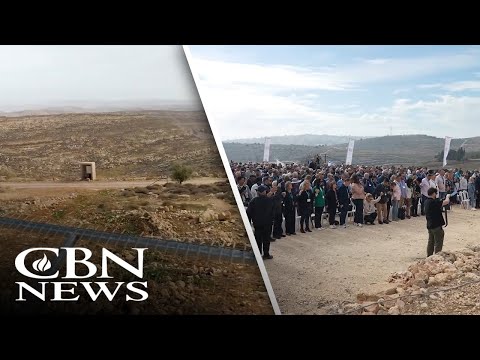
I went there to report a feature I wrote and produced for CBN News’s Jerusalem Dateline. We were examining what Rabbi Dee believes Western governments and media are missing in their coverage of Judea and Samaria, also known as the West Bank. But sitting with him, I was reminded that behind the political arguments are people whose lives have been changed forever.
A loss beyond words
In April 2023, Palestinian terrorists attacked the Dee family in a highway ambush. Rabbi Dee lost his wife, Lucy, and his daughters, Maia and Rina. There is no adequate language for that kind of horror. A wife. Two daughters. Three people whose absence a family must carry every day.
Hearing his story was both sobering and encouraging at the same time. Sobering because the tragedy is unimaginably horrible. Encouraging because the man sitting before me had not allowed that evil to have the final word.
I do not mean that he has somehow moved beyond his grief, or that a person can simply overcome a loss like this and leave it behind. What struck me was his determination to keep speaking, keep building, and keep looking for a future in which other families would not have to suffer as his has.
To me, that perseverance is a true testament to God’s hand on the Jewish people and the resilience of this land. I saw a man confronting unimaginable darkness without surrendering his capacity for hope.
The stories behind the headlines
Our report explored controversy over reports of Israeli settler violence and Britain’s announced plans to ban imports from Israeli settlements. Rabbi Dee believes the coverage driving those debates too often leaves out attacks against Israelis and the wider reality experienced by families living here.
One point was important to make clear: he condemns violence against Palestinians. He described murders committed by Israelis as horrendous and unacceptable, and stressed that offenders must face justice under Israeli law. His argument was not that wrongdoing should be excused. It was that the whole story should be told.
He also offered his assessment of the imbalance in coverage and the political incentives he believes influence Western policy. Those are his arguments, not a substitute for independently examining every incident. But listening to a father who had buried three members of his family, I understood why the question of whose suffering receives attention is anything but abstract for him.
As a journalist, I believe we have a responsibility to resist reducing people to labels. We can report difficult questions, examine competing claims, and still remember that every family touched by violence deserves to be seen.
What kind of future are we encouraging?
Our conversation also turned to the Palestinian Authority and the payments critics call “pay for slay.” Rabbi Dee argued that financial rewards connected to terrorism create destructive incentives, while ordinary Palestinian families need opportunity, security, and a better future for their children.
What stood out to me was that he did not describe ordinary Palestinians as inherently evil. He spoke of people who, like us, want their children to have good lives. His criticism was directed at the systems and leadership he believes keep those families trapped.
I asked him a practical question: What is your vision for peaceful coexistence in Judea and Samaria?
He told me about meeting sheikhs from Hebron who, he said, wanted an alternative to Palestinian Authority rule and a path toward direct economic ties with Israel. He described their desire for work and independence, and the loss of access to many jobs in Israel following the security restrictions after October 7.
That proposal is not an established solution, and the sheikhs’ aspirations are presented here as Rabbi Dee described them. But the question underneath it matters: Are international leaders listening to the people who must actually live with the consequences of their policies?
Rabbi Dee urged those leaders to meet ordinary Palestinians and ask what they want. Whatever one’s position on the political arrangements, I believe that is a question worth taking seriously.
Hope from an unexpected place
Toward the end of our conversation, I asked what gives him hope amid so much tragedy and political hostility. His answer was especially meaningful to me: the support he receives from evangelical Christians who stand with Israel.
“Thank God it gives me hope for humanity.”
He described how much those encounters lift him up. After everything he has endured, he still finds encouragement in people willing to distinguish right from wrong and stand against evil.
As a Christian, I heard that as both an encouragement and a responsibility. Our solidarity should never be merely a slogan. It should mean showing up, listening, grieving with those who grieve, and refusing to look away from their humanity.
What I carried home from Efrat
I am grateful I had the opportunity to tell this story. Reporting from Israel often means navigating arguments that stretch across generations. This interview brought me back to something more immediate: a father’s love, a family’s devastating loss, and the extraordinary courage required to keep living with purpose.
Rabbi Dee’s resilience does not make the tragedy smaller. It makes his determination to build something good in its aftermath all the more remarkable.
I left Efrat sobered by what I had heard and encouraged by the man I had met. To witness that kind of perseverance is to be reminded that the story of this land is not only one of conflict. It is also a story of faith, endurance, and hope. For me, it was another powerful reminder of God’s hand on the Jewish people, and of how much I still have to learn from the people whose stories I am privileged to tell.
Keep reading
Browse all writing →
UK Terror Plot Suspects Out on Bail as Trump Denies Iran Offer
Five suspects arrested near a British air base used by American bombers are out on bail, drawing a sharp response from President Trump, as Washington and Tehran trade messages over a possible nuclear agreement. Aired on The 700 Club.

Dead Jew, No News? A Yom Kippur Attack and the Stories the World Misses
Two attacks in two days left an Israeli father dead and a reservist fighting for his life. The violence was real. So was the silence surrounding it.

Happy New Year. Iran Is Reloading.
Nothing says Happy New Year quite like ballistic missiles.
More from Jerusalem
Dead Jew, No News? A Yom Kippur Attack and the Stories the World Misses
Happy New Year. Iran Is Reloading.

Will the BDS Movement Make Its Way Into the Boardroom?