A Tiny Menorah and a Very Long Memory
A 1,300 year old lead pendant found beneath the Temple Mount carries a menorah on both sides, and a story that outlasted empires.
There is an old saying in Israel that every stone tells a story.
Spend enough time in Jerusalem and you begin to suspect the stones are actually competing with one another.
Turn over the right piece of earth and somebody finds a coin from a revolt, a seal belonging to a biblical official, a wall everyone had forgotten existed, or occasionally something that sends archaeologists into the sort of excitement normally reserved for normal people finding an extra order of fries at the bottom of the bag.
This time, the object is tiny.
Very tiny.
A small lead pendant, roughly 1,300 years old, discovered in an excavation beneath the southwest corner of the Temple Mount.
On both sides of it is something unmistakable.
A menorah.
Dr. Filip Vukosavovic of the Israel Antiquities Authority described the discovery to me with the kind of enthusiasm archaeologists develop after spending their careers staring at dirt and occasionally being rewarded with something extraordinary.
It's such a small thing. It tells us a huge story.
And it does.
The pendant comes from a period when we know relatively little about Jewish life in Jerusalem. During much of the Byzantine era, Jews faced severe restrictions in the city. For centuries, Jerusalem was overwhelmingly Christian under Byzantine rule, and Jewish residence and access were limited.
Then history shifted again.
Toward the end of the Byzantine period and into the early Islamic era, Jews began returning to Jerusalem in greater numbers.
And where did some of them settle?
Near the Temple Mount.
Of course they did.
If you have followed Jewish history for more than fourteen minutes, you will recognize the pattern.
Empires rise. Empires fall. Governments change. Borders move. Rulers arrive with grand titles and leave as archaeological layers.
And the Jewish people keep remembering Jerusalem.
That is what makes this little pendant so fascinating.
The Temple itself had been destroyed nearly six centuries before someone wore it. The Roman legions had reduced the Second Temple to ruins in AD 70.
Generations had been born and died since then. The political world had changed repeatedly.
Yet somebody was still wearing a menorah around his or her neck.
Not a Byzantine cross.
Not an imperial symbol.
A menorah.
A symbol of the Temple.
A symbol of Jewish worship.
A symbol of a connection to Jerusalem that had survived centuries without the Temple itself.
Filip put it simply.
Even though the Temple had been destroyed hundreds of years earlier, he said, "still, that connection is so strong."
That sentence stayed with me.
Because archaeology has an annoying habit of refusing to cooperate with whatever narrative happens to be fashionable this week.
Artifacts do not have social media accounts.
Pottery does not issue statements.
Coins do not care about your politics.
And a lead pendant buried beneath Jerusalem for more than a millennium is spectacularly uninterested in whatever argument someone is currently having on X.
It simply exists.
That does not mean archaeology answers every historical question cleanly. It does not. Archaeologists disagree about dates, interpretations, populations, and historical context all the time. This is scholarship, not a magic trick.
But physical evidence matters.
Dr. Oren Gutfeld, an archaeologist from Hebrew University, told me that we simply do not know very much about Jewish life in Jerusalem during the late Byzantine period. Under Emperor Justinian, who ruled from 527 to 565, Jewish life in the city faced significant restrictions.
Outside Jerusalem, the picture could look quite different. Jewish communities flourished in places such as the Galilee, where elaborate synagogues testify to vibrant communal life.
Jerusalem was another story.
And that is precisely why this pendant matters.
Gutfeld explained that the artifact provides evidence that Jews were still coming to Jerusalem, praying here, visiting holy places, and maintaining a relationship with the city even during centuries when their presence was constrained.
One pendant cannot tell us everything.
But it can tell us something.
Someone carried Jerusalem close to his heart.
Literally.
I recently stood at the Tower of David looking at maps showing the changing shape of Jerusalem across the centuries. During the Byzantine period, the Temple Mount appears largely empty of major structures following the destruction of the Temple. Move forward into the early Islamic period and the landscape changes dramatically. The Dome of the Rock appears. Al Aqsa Mosque appears. Umayyad palaces rise along the southern edge of the Temple Mount.
And beneath later construction were the remains of earlier communities.
Jerusalem is like that.
Nobody really gets the last word here.
They just get the next layer.
The menorah pendant eventually made its way to the Knesset, Israel's parliament, before I saw it at the Israel Antiquities Authority.
I asked Filip why such a small object had been taken there.
His answer was essentially that Jewish history in this land is not confined to one century or one archaeological period. Objects like this become pieces in a much larger record of Jewish presence stretching across thousands of years.
That does not make every political argument simple.
Nothing in Jerusalem is simple.
Anyone who tells you otherwise is either selling something or has been here for approximately forty eight hours.
But it does make history harder to erase.
This is one of the things I have come to appreciate most about living and reporting from Jerusalem.
The modern arguments here are loud.
The ancient evidence is quiet.
And sometimes the quiet things speak with remarkable force.
A tiny pendant does not shout.
It does not need to.
For roughly 1,300 years it sat beneath the earth near the Temple Mount, carrying the image of a menorah from one generation into another.
Kingdoms disappeared above it.
Languages changed.
Armies came and went.
Religions battled over Jerusalem.
Historians wrote books.
Politicians gave speeches.
And beneath all of it, this little piece of lead waited.
Then somebody picked it up.
And the story continued.
From Jerusalem,
Joshua
Keep reading
Browse all writing →
Stealing Israel's History: Chasing Antiquities Looters, and Why Charisma Picked Up the Story
Almost every night, thieves dig for artifacts across Israel. I reported on the fight to stop them for CBN News, and Charisma Magazine shared the story with its readers.

A Voice From the Desert: The Great Isaiah Scroll and the Caves of Qumran
Standing before the Great Isaiah Scroll and hearing Dan Farkash describe his priestly connection to Qumran made these stories deeply personal for me.
The Chocolate Challah That Stopped the Newsroom
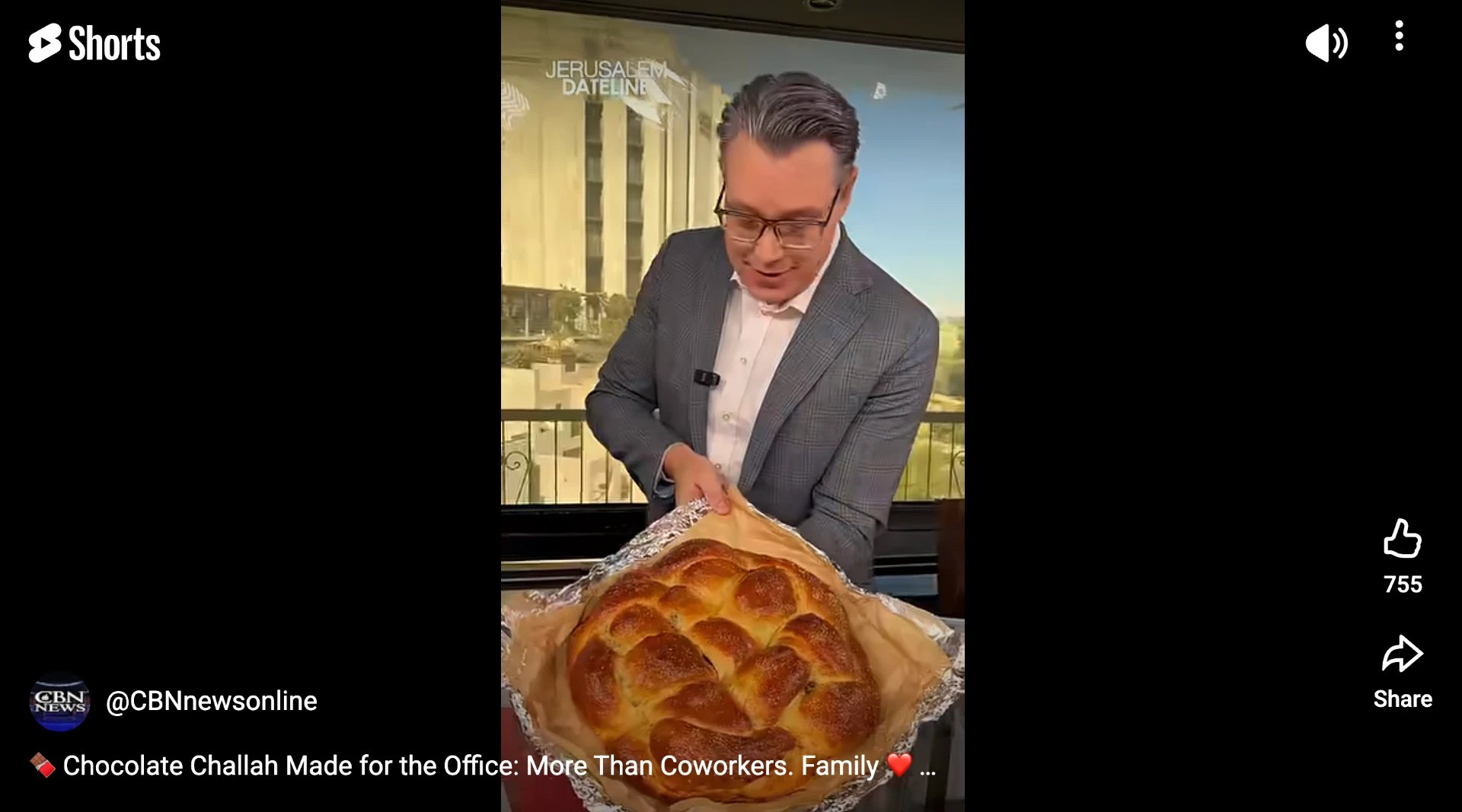
A homemade chocolate challah from Rachael Swanson brought our Jerusalem newsroom to a happy standstill, a sweet reminder that the team behind the headlines is family.
More from Jerusalem
A Voice From the Desert: The Great Isaiah Scroll and the Caves of Qumran
The Chocolate Challah That Stopped the Newsroom
The God Hannah Prayed To Is Still Listening