The Stones Still Speak: Beauty From Ashes at Bethsaida
A wildfire swept across el Araj, the site many believe is biblical Bethsaida, exposing more of the fishing village where Peter, Andrew, and Philip began their lives.
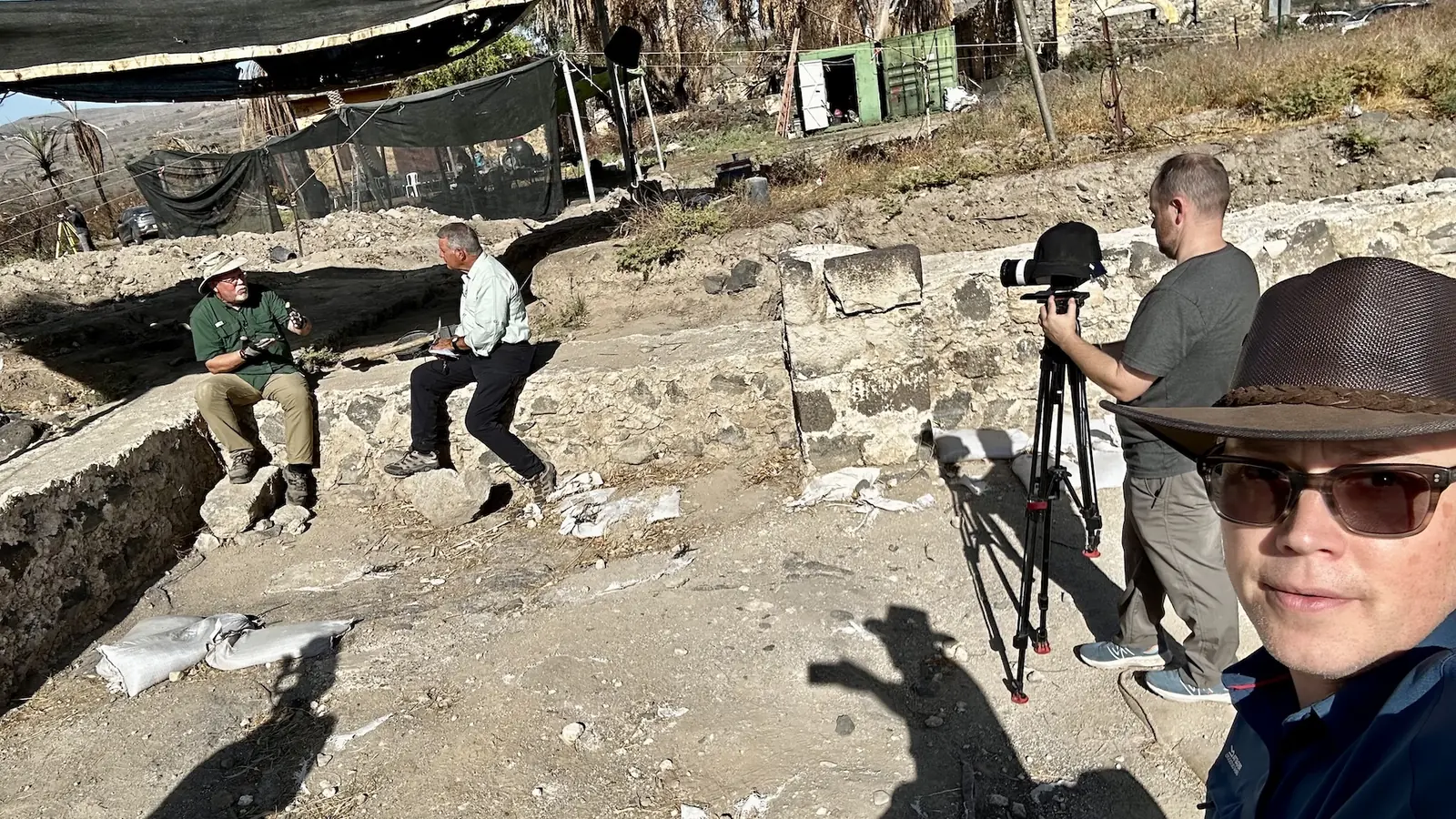
One of the strange privileges of reporting from Israel is that the Bible is constantly refusing to remain politely confined to the page.
You read about a village in the Gospel of John, drive a couple of hours north, stand beside the Sea of Galilee, and suddenly archaeologists are pulling mosaics, stone vessels, fishing weights, walls, columns, and inscriptions out of the dirt.
Apparently history has no interest in staying buried.
That is especially true at el Araj, a site on the northern shore of the Sea of Galilee that a growing number of archaeologists and historians believe is ancient Bethsaida.
Bethsaida matters because the Gospels matter.
John identifies it as the hometown of Peter, Andrew, and Philip. Jesus healed a blind man there. The feeding of the 5,000 took place in the region around Bethsaida. Some of the men who would eventually carry the Gospel into the Roman world began their lives in this little fishing community.
"After Jerusalem, Capernaum, Bethsaida is the most mentioned site in the Gospels."
Dr. Steven Notley
That is quite a résumé for a place that essentially disappeared.
And then came the fire.
Beauty From Ashes
In late July, as Notley and his team prepared for another excavation season, a wildfire tore across the area for roughly 17 hours.
Notley and his wife had just arrived on the western side of the Sea of Galilee when they noticed the fire across the lake.
They drove around to investigate.
What they found was not encouraging.
"We drove to the entrance and saw the eucalyptus trees here going up in flames. Oh my goodness. You know, this is going to upend all of our excavation."
Dr. Steven Notley
Not exactly the traditional archaeological welcome committee.
The following morning, however, the team discovered something remarkable. The fire had approached the Byzantine basilica they had been excavating, burned through the surrounding vegetation, and then stopped.
Right beside it.
Notley said the flames reached the tarps lying beside the ancient walls.
"The fire came right up. The grass was all dead. It should have just continued."
Dr. Steven Notley
It did not.
One of the excavation leaders, Dr. Motti Aviam, described it as the hand of God.
But the fire did something else.
It burned away thick undergrowth surrounding the excavation and exposed portions of the ancient settlement that archaeologists had never been able to see.
Suddenly there were columns.
Walls.
Pottery.
Structures.
An entire landscape began emerging from beneath what had covered it.
Notley summarized the moment with language Isaiah would have appreciated.
"I like to refer to it as that God gave us beauty for ashes."
Dr. Steven Notley
Wildfire is nobody's preferred excavation method. Archaeologists generally favor brushes, trowels, painstaking documentation, and considerably less running for their lives.
But once the fire passed, the team realized it had revealed something important.
Bethsaida appeared to be much larger than previously understood.
Aviam and his team walked into the burned area while smoke still hung in the air.
"We came out almost completely black. Whole clothes, face, hands. But what we discovered was very important. We discovered how large the site is."
Dr. Motti Aviam
The village that had largely disappeared from history was suddenly becoming visible again.
Peter, the Keys, and a Mosaic Beneath the Dirt
The wildfire is only the latest chapter in the story of el Araj.
Excavations began there in 2016. Then, in 2022, archaeologists discovered something that dramatically strengthened the case for identifying the site as biblical Bethsaida.
Beneath the remains of a Byzantine basilica, researchers uncovered a mosaic containing a Greek inscription honoring the Apostle Peter.
More specifically, it referred to him as the "keeper of the keys."
That language immediately brings to mind Jesus' words to Peter in Matthew 16 about the keys of the kingdom of heaven.
Aviam told us the inscription is extraordinarily unusual.
"There is no other inscription in the Mediterranean with the name or the title of Saint Peter."
Dr. Motti Aviam
And then he added the detail that makes the discovery particularly fascinating.
"It\'s the only place where he is mentioned as the keeper of the keys."
Dr. Motti Aviam
Standing beside the mosaic, Chris Mitchell had the reaction most Christians probably would.
"You get chills seeing that."
Chris Mitchell
Yes.
You do.
There is a difference between reading about Peter while sitting at your kitchen table and standing in a first century fishing village beneath a church where Christians centuries later were still remembering Peter.
That does not mean archaeology proves every theological claim of Christianity.
Faith is not built upon a pottery shard.
But archaeology can tell us whether the world described in Scripture resembles the world buried beneath our feet.
And at Bethsaida, increasingly, it does.
Was This Really Peter\'s Hometown?
Most Christians associate Peter with Capernaum.
There is a good reason for that.
The Gospels place Peter's home there, including the account in which Jesus heals his mother in law.
But John 1:44 says something else.
Peter, Andrew, and Philip were from Bethsaida.
Those details are not necessarily contradictory. Bethsaida may have been Peter's hometown while Capernaum became his later residence.
The question for archaeologists has been much simpler.
Where was Bethsaida?
Notley began with a surprisingly radical research technique.
He read the texts.
I know. Try to contain yourselves.
He compared the New Testament accounts with the Jewish historian Josephus and the geography surrounding the Sea of Galilee.
"I read the sources, the eyewitnesses who had actually walked the streets of Bethsaida."
Dr. Steven Notley
Then the team excavated to see whether the archaeology matched the historical descriptions.
According to Notley, it does.
"It\'s a very simple thing of sort of establishing that, bringing those together and exploring and seeing, starting to dig and seeing if the evidence that comes up out of the ground matches the historical description, which this place does."
Dr. Steven Notley
That approach is worth remembering.
Archaeology should not force the ground to say what we want it to say.
Neither should biblical scholarship begin with the assumption that the Gospel writers were too geographically confused to know where they were.
Read the sources.
Study the land.
Dig.
Then see what comes out.
Apparently the Galileans Could Read
One of my favorite discoveries from the excavation is considerably less dramatic than a church mosaic.
An inkwell.
Dr. Carrie Wood, a visiting scholar from Regent University, explained why something so small matters.
For years, Galileans have sometimes been caricatured as provincial, unsophisticated fishermen.
Or, as she put it:
"They\'re kind of hicks from the sticks, so to speak, and they\'re uneducated."
Dr. Carrie Wood
Then archaeologists found an inkwell.
That is mildly inconvenient for the stereotype.
The excavation has also uncovered fishing weights and Jewish stone vessels associated with ritual purity.
Taken together, Wood said the finds reveal a more interesting picture of the community.
"You\'ve got this beautiful picture of a Jewish ritually pure people who are wanting to be ritually pure, fishing village that is literate."
Dr. Carrie Wood
In other words, the people who lived here fished.
They participated seriously in Jewish religious life.
And at least some of them wrote.
That sounds considerably closer to the Jewish world of the Gospels than the cartoon version sometimes presented by people who imagine first century Galilee as populated entirely by barefoot bumpkins.
Faith With Dirt Under Its Fingernails
For Notley, the significance of Bethsaida goes beyond identifying another dot on a biblical map.
He is a scholar.
He is also a Christian.
And he makes no attempt to hide either fact.
"My career has been invested in trying to understand better the Gospels as they unfold in this land, in terms of land and culture and language."
Dr. Steven Notley
Standing among the ruins, he described what archaeology can contribute to faith.
"It reinforces for me the reality of my faith, that it\'s not pie in the sky, it\'s not fiction, it\'s not myth. It\'s something that has substance to it, physicality to it."
Dr. Steven Notley
That word is important.
Physicality.
Christianity makes astonishing spiritual claims, but it makes them within history.
Jesus was born somewhere.
He walked somewhere.
He ate meals.
He crossed lakes.
He entered villages.
He called fishermen.
He stood beneath an actual sun on actual ground.
The Gospel does not begin, "Once upon a time in a mystical realm far, far away."
It begins in places.
Nazareth.
Capernaum.
Jerusalem.
Bethsaida.
Dr. Carlos Campo of the Museum of the Bible described what happens when Christians encounter those places.
They have read about them all their lives, he said, but when they come to the land and walk where Jesus walked, they feel "the Bible coming to life."
That is difficult to explain until it happens to you.
Then it becomes difficult to forget.
The Stones Still Speak
Near the end of our conversation, Chris Mitchell looked at the ruins and said simply:
"The stones speaking."
Chris Mitchell
Notley agreed.
"I think they cry out and they speak to us of the truth."
Dr. Steven Notley
That does not mean every archaeological discovery comes stamped with a divine certificate of authenticity.
Archaeology remains archaeology.
Sites are debated.
Dates are debated.
Interpretations change as new evidence emerges.
That is how serious scholarship works.
But something remarkable is happening at el Araj.
A village remembered in the Gospels disappeared for centuries.
Researchers followed the ancient texts back to the shores of Galilee.
They dug.
They found a first century Jewish fishing community.
They uncovered a Byzantine church.
Inside it they discovered an inscription honoring Peter as the keeper of the keys.
Then a wildfire swept across the site and exposed even more of the ancient settlement.
Notley believes we are approaching the end of a process that began when explorers started rediscovering biblical sites during the nineteenth century.
Bethsaida, he noted, may represent something extraordinary.
"This is the last city mentioned in the Gospels that no one knew where it was."
Dr. Steven Notley
Perhaps not anymore.
Two thousand years after fishermen left this shore to follow a rabbi from Nazareth, the stones are speaking again.
And once again, we would probably do well to listen.
*Reporting source: Jerusalem Dateline, "Bethsaida (el Araj) Wildfire & Discoveries," JD15022.*
Keep reading
Browse all writing →
Stealing Israel's History: Chasing Antiquities Looters, and Why Charisma Picked Up the Story
Almost every night, thieves dig for artifacts across Israel. I reported on the fight to stop them for CBN News, and Charisma Magazine shared the story with its readers.

A Voice From the Desert: The Great Isaiah Scroll and the Caves of Qumran
Standing before the Great Isaiah Scroll and hearing Dan Farkash describe his priestly connection to Qumran made these stories deeply personal for me.
Happy New Year. Iran Is Reloading.
Nothing says Happy New Year quite like ballistic missiles.